Screens and Social Media Use in Youth
Screens and social media use feel unavoidable these days - but it’s not all bad. It helps people feel connected to others (globally!), find a community they align with, as well as develop a social support network that they perhaps would not have found otherwise. It also grants us all access to real-time news and information, and helps with business aspects such as advertising or brand awareness. However, what are the risks?
What does the federal government say about social media use in youth?
Studies show that the risks are real, measurable, and increasing:
“Youth who experience online victimization are significantly more likely to report poor mental health outcomes, including suicidal ideation.
One in four youth aged 12–17 have reported experiencing cyberbullying.
Police-reported incidents of online child sexual abuse and exploitation have increased significantly in recent years, reflecting both rising prevalence and evolving digital risks.
New technologies, including artificial intelligence (AI), are changing how harmful content is created, amplified, and experienced online.” (Canada.ca)
Points 1 & 2: Online victimization and mental health outcomes
Mental Health Research Canada conducted a study on screen time: “Associations Between Social Media Use, Personal Screen Time, and Mental Health Indicators Among Canadian Youth” using data collected January 2024 -February 2025, from Polls 19-23 of Canada-wide surveys. The data represents 27,039 respondents aged 16 and older who answered questions about their mental health in a blind online survey, and the key findings were as follows:
“Youth report the longest screen time and highest social media use of any age group, and also the most severe mental health symptoms.
Those spending 7+ hours on personal screen time are significantly more likely to experience anxiety, depression, and suicidal thoughts.
Experiences of cybervictimization are linked to a threefold increase in suicidal ideation.
Youth who use platforms like TikTok and Snapchat report higher rates of suicidal ideation than the national average.
Resilience and strong social connections help buffer the mental health impacts of screen time and cyberbullying.”
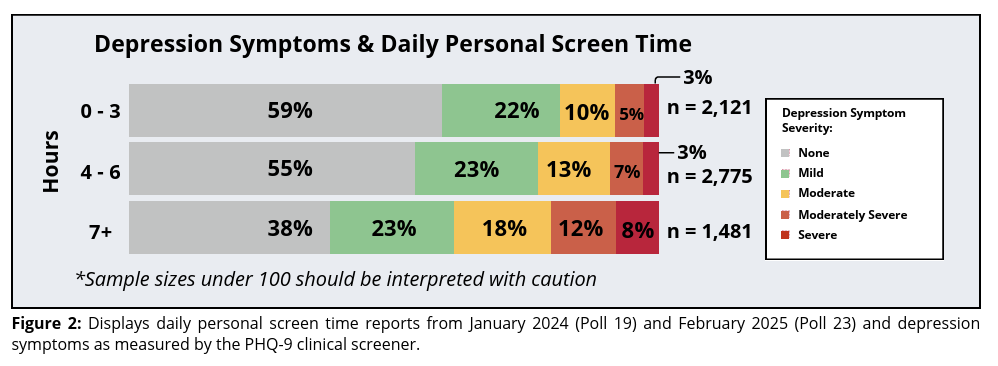
The study concluded that longer screen time is associated with poorer mental health indicators, shown in higher clinical ratings of anxiety, depression, and psychological distress, as well as reports of suicidal ideation. Youth are considered the most at-risk age group, with the highest reports of screen time, harmful content/experiences online, and poorer mental health indicators. This does not mean that social media or screen time causes these issues, but that there is an association and there are many other factors to be considered.
Points 3 & 4: Online child sexual abuse and exploitation, artificial intelligence
Online offenders use child-friendly apps to meet and exploit children, and it is more common in Canada than we may realize: In 2023, there were 19,516 police-reported incidents, a 59% increase from 2022. The Canadian government offers more information here.
Child sexual abuse often occurs online and may take various forms:
“Child sexual abuse material, fictitious or otherwise in forms of audio, video, or images
Self-generated materials and sexting – Youth-generated explicit images/videos on the Internet, which are often further distributed without consent
Sexual extortion – Use of coercion and threats to extort child sexual exploitation images/videos from youth (either by other youth or adult offenders), or "financial" sexual extortion where offenders threaten to release the compromising material unless the victim sends payment
Grooming and luring – Use of applications and platforms to connect with children and youth for the purpose of sexually exploiting them
Live child sexual abuse streaming – Viewing of child sexual abuse in real-time, often involves the offender directing the abuse; and
Made-to-order content – Ordering videos/images to suit offenders' preferences” (Public Safety)
The rapid advances in AI development have also added to the impact. AI chatbots can interact directly with users, “sometimes reinforcing harmful behaviours or providing unsafe responses in sensitive situations” (Canada.ca). According to the APA (and a 2026 Pew Research Center report), more than half of U.S. adolescents say they use AI chatbots to help with schoolwork, as well as entertainment or companionship (APA.org). However, it is noted by researchers that “what matters is not whether students use AI but how and why they use it” (APA.org). There can be benefits to AI use in the academic field, including use in tutoring, analyzing student performance and helping adjust teaching accordingly, or helping to integrate special education with general education. “If we’re able to do it right, generative AI can help make the education system more inclusive” (APA.org). Social AI use, such as asking for advice, or having conversations with a chatbot, may pose an issue as it replaces roles that would previously have been filled by another person. However, if a child has limited access to peers or a support network (e.g., because of a remote location) or if neurodivergent children want to practice offline interactions, AI interactions could potentially be of benefit. As with many situations, there is not a one-size-fits-all answer, and the APA provides thoughtful considerations here.
What’s being done about these concerns?
On June 10, 2026, the Government of Canada introduced Bill C-34, the Safe Social Media Act, which includes The Digital Safety Act and the Digital Safety Commission of Canada Act. The bill introduces a structure to improve online safety, ensures that digital services are “transparent and accountable for the risks their services create, and creates a new Digital Safety Commission of Canada to enforce the Digital Safety Act and support victims of online harms.” (Canada.ca)
The Digital Safety Act outlines new safety requirements for social media services and AI chatbot services. According to this act, these services are required to identify risks of harm on their platforms, implementing measures to address risks, incoporate safety and age-appropriate design features, amongst other safety features. As well as setting new standards for online safety by conducting research, the goal is to be able to enforce legislative and regulatory obligations.
What can I do about this?
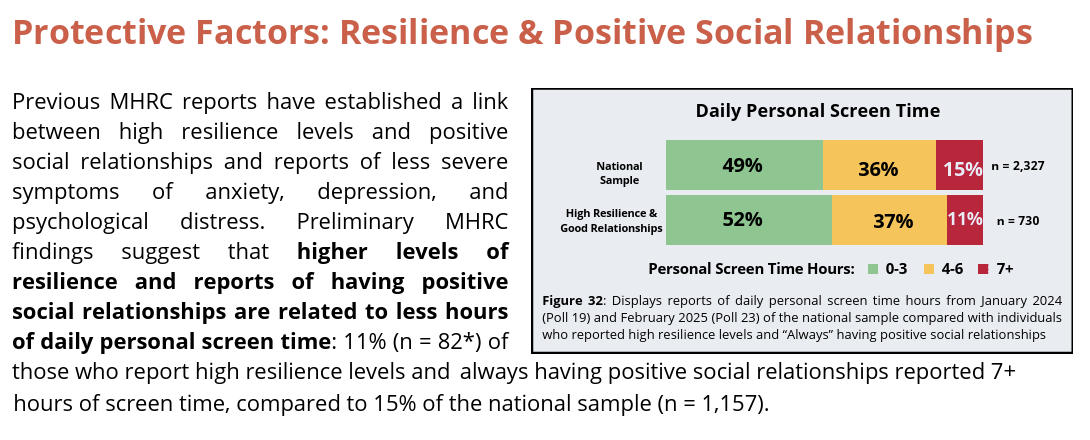
Positive social relationships act as protective factors against negative mental health indicators and are associated with less screen time and harmful online experiences. The study referenced earlier notes the link between high levels of resiliency and less severe reported symptoms of anxiety, depression, and psychological distress. Supporting your children in fostering these relationships can be helpful in the short and long-term.
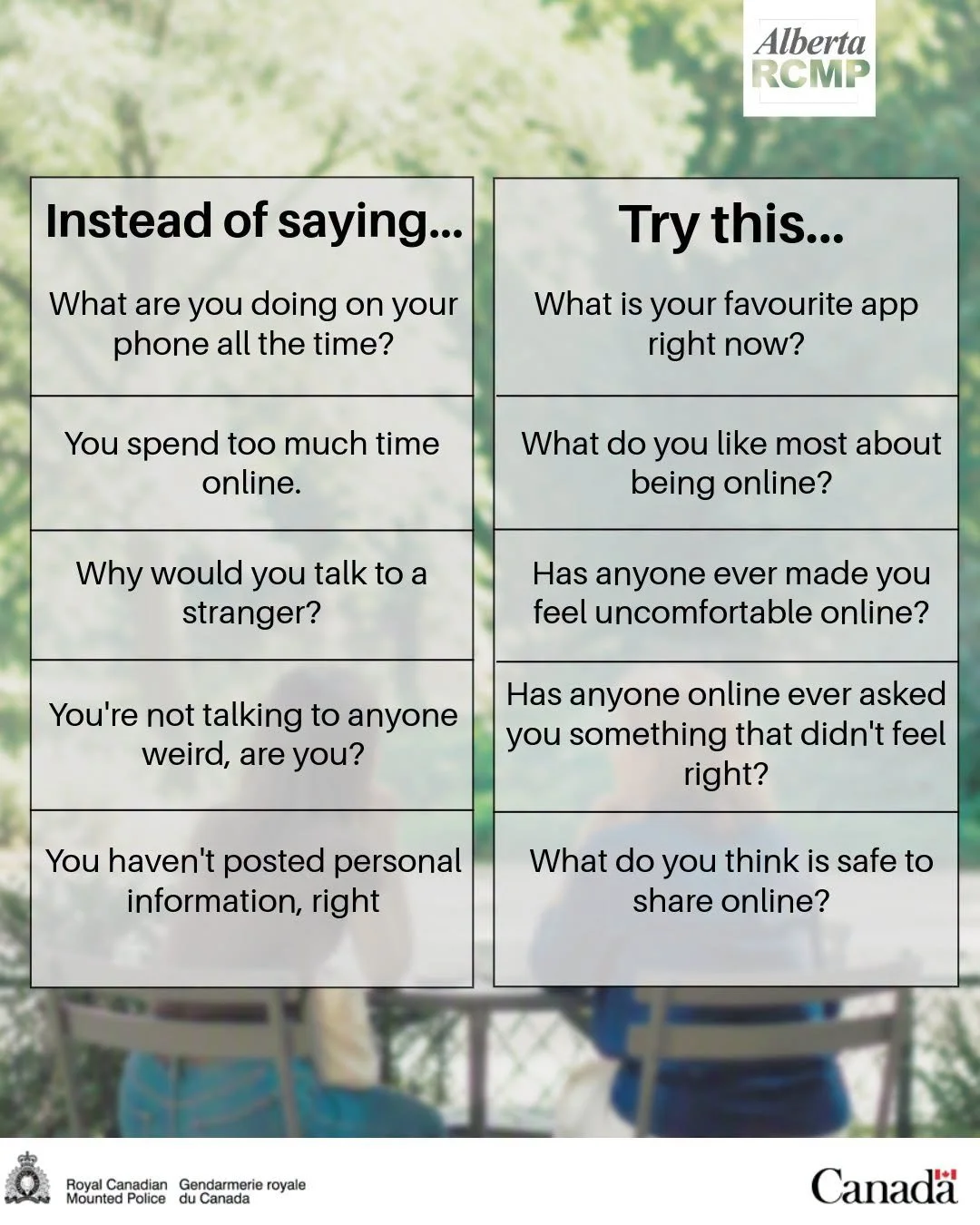
The RCMP shares helpful tips regarding discussing online presence with teens. When it comes to online safety, the goal isn't to know everything your child is doing online; rather, it is to create an environment where they feel comfortable coming to you when something doesn't feel right, before small concerns become bigger problems. As noted in the original post, open-ended, curiosity-driven questions are beneficial and help build trust in the relationship. “Opening up channels of communication—asking whether children are using these tools and how—can help parents spot problems early and guide healthier boundaries” (APA.org). As social media and online presence is a major part of connecting with others in these age ranges, removing access altogether is likely not the most helpful response, either. Each individual’s situation has nuance and requires thoughtful consideration of all factors.
In general, a few considerations to keep in mind:
Model healthy screen use
Encourage daily “screen-free” times, especially for family meals or activities together
Create a family media plan: https://www.healthychildren.org/english/fmp/pages/mediaplan.aspx
Discourage being on more than one screen at a time (“media multitasking”)
Learn about parental controls and privacy settings
Encourage meaningful screen use
While each situation is different, it is generally not advised to completely revoke access to devices; instead, work towards setting age-appropriate limits (in both content and amount of time on screens) (CPS.ca)
Overall, managing social media and screens is a joint effort between parents, educators, mental health professionals, and policy makers to help youth navigate social media in ways that are healthy, safe, and productive.
Resources
For Parents
For Youth
The Amazing Generation: Your Guide to Fun and Freedom in a Screen-Filled World: https://a.co/d/01EICEXQ
Good Pictures Bad Pictures: https://www.defendyoungminds.com/product/good-pictures-bad-pictures